

Chimera Learns to Draw: Qwen-Image-2.1 on a GPNPU
Chimera didn't need new hardware to learn to draw. After a year of bringing new modalities to the same programmable cores, we now have our first text-to-image model, Qwen-Image-2.1. Eight simulated QC-Ultra cores, each with its own memory bandwidth, turn a one-line prompt into a 256 × 256 image in about 0.3 seconds. Just in time for Thanksgiving, here's the turkey.
Written by Jacques van Rhyn and Daniel Chvat
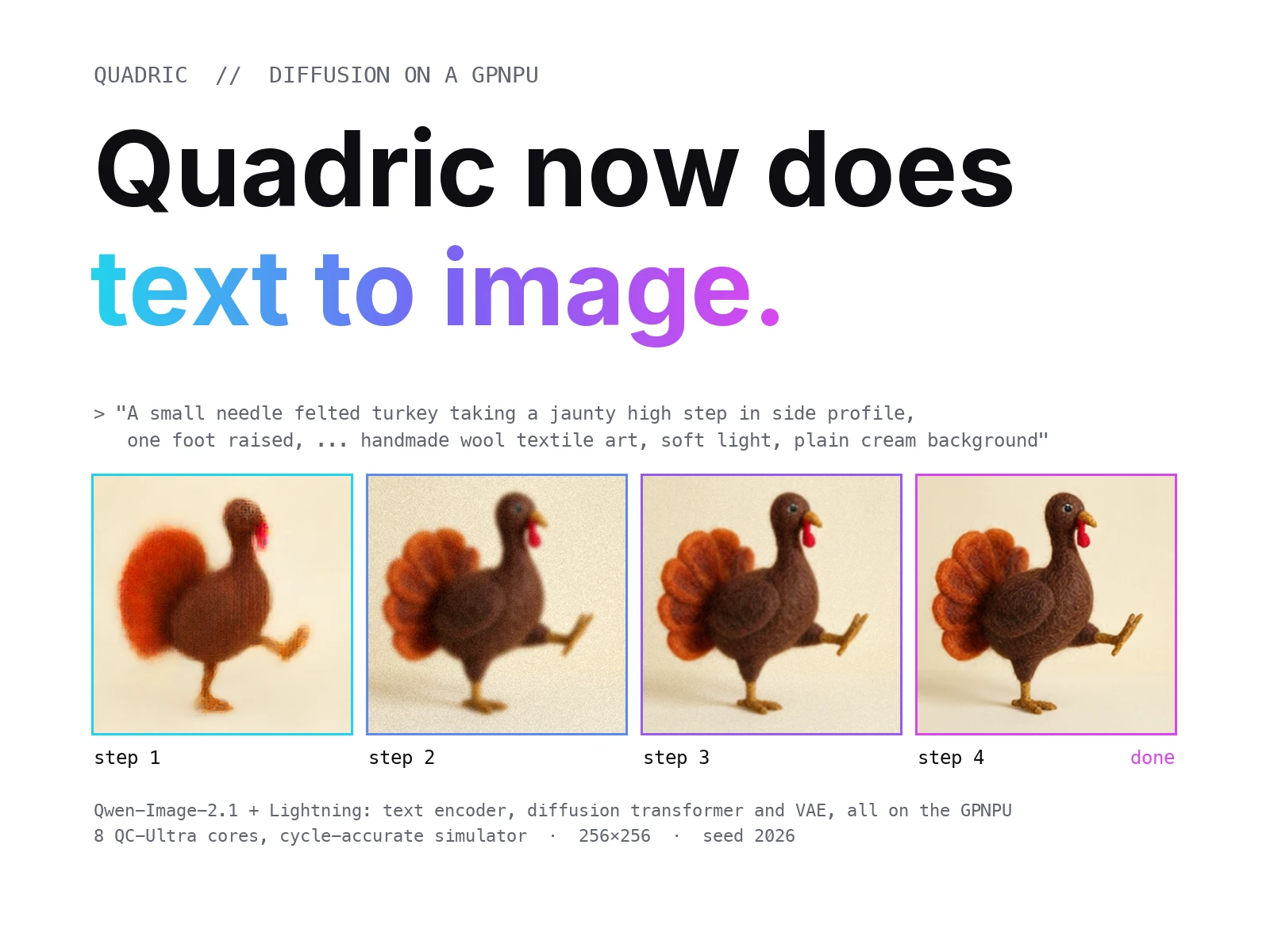

Generated on Chimera. Prompt: "A small needle felted turkey taking a jaunty high step in side profile, one foot raised, upright neck, chestnut brown wool body, rust orange tail feathers and a small red wattle, handmade wool textile art, soft light, plain cream background." 256 × 256, four steps, seed 2026, on our cycle-accurate simulator.
This turkey came out of a GPNPU. Every stage that made it, from reading the prompt to decoding the final pixels, ran on Chimera cores in our instruction-set simulator.
The model is Qwen-Image-2.1, Alibaba's open text-to-image model, with the LightX2V Lightning checkpoint, which produces an image in four denoising steps rather than the base model's forty. It's our first text-to-image model, and it runs on the same cores and the same SDK as the models that, this year, taught Chimera to watch video, drive, control robots and talk.
Why image generation is a different workload
The models we've written about recently, like V-JEPA, Alpamayo and pi0.5, take in pixels and produce an understanding of them. Qwen-Image runs the other way, and it chains three very different networks:
- A text encoder. Qwen-Image reads the prompt with Qwen3-VL, a 36-layer, 8B-class vision-language model. This is the same family of model as the LLMs we already run, so it's mostly matrix multiplies and grouped-query attention.
- A diffusion transformer. The core of the model is a 32-layer, 4,096-wide transformer that starts from random noise and removes some of it on each step, guided by the prompt. Text and image tokens attend to each other in every layer, and every layer is modulated by the current timestep. With Lightning, this step only needs to run four times.
- A VAE decoder. A stack of convolutions and upsamplers turns the transformer's compact latent image back into pixels.
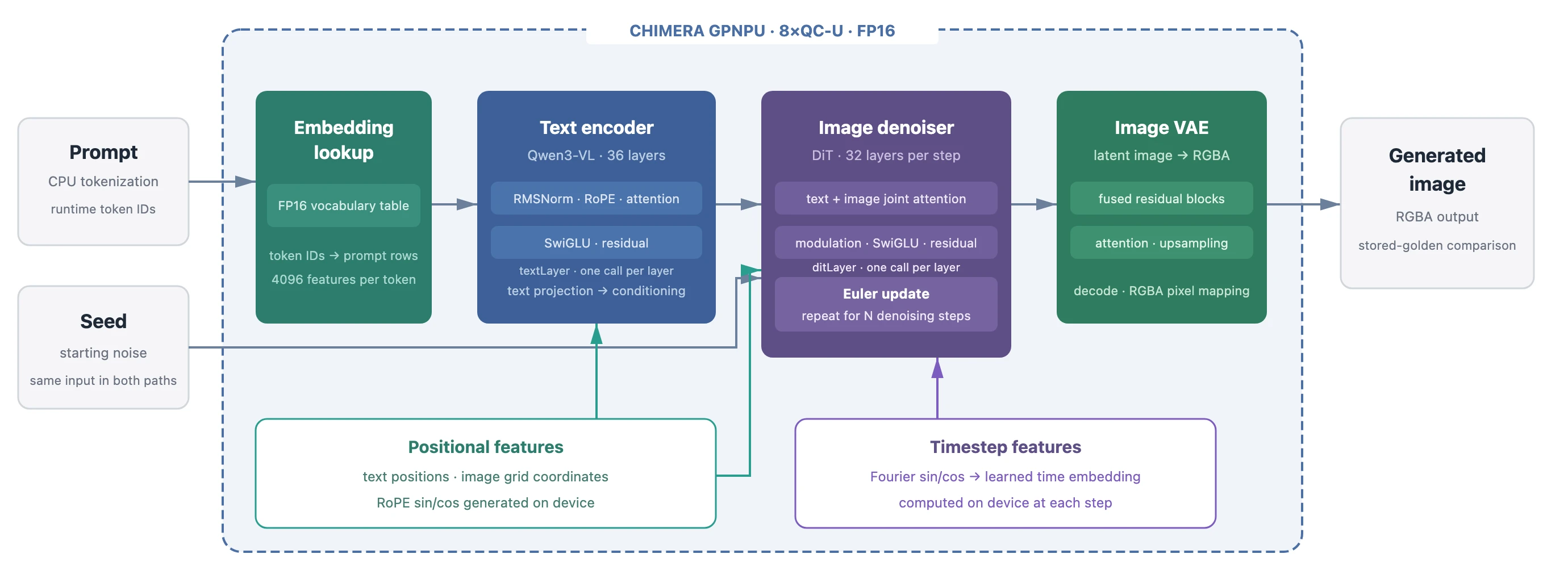
The whole pipeline, from the text encoder to the VAE, runs on the GPNPU. Tap the diagram to open it full size.
Most fixed-function NPUs are built around one shape of network. Convolution engines handle the VAE and struggle with attention; transformer engines go the other way. Neither was designed for the glue between them: rotary tables, timestep features, adaptive normalization and the update between denoising steps. Teaching that chip to draw means either waiting for new silicon or shipping the gaps to the CPU. Teaching Chimera meant writing new kernels in C++ for the cores it already had.
How it was built
Agents did the port. They lowered each part of the network to ChiPy programs and CCL kernels, about 13,000 lines in all, covering attention, convolution, the transformer layers and the VAE. They did a remarkably good job of it. Fed the same inputs as the official FP16 model, every stage we checked on the simulator matches its output almost exactly.
| Block, checked independently | Cosine similarity to the FP16 model |
|---|---|
| Final text-encoder layer | 0.999999 |
| Conditioning | 0.99999996 |
| Diffusion transformer layer | 0.99999999 |
| Noise prediction | 0.99999994 |
| Updated latents | 0.99999998 |
Independent block checks: each block is fed the FP16 model's own inputs and compared against its output.
The numbers
Measured on our cycle-accurate instruction-set simulator, for one 256 × 256 image. Each QC-Ultra core has 8 MB of on-chip memory and 16 MACs per processing element, runs at 1.0 GHz, and gets its own 128 GB/s of DDR read bandwidth and 128 GB/s of write bandwidth, about 1 TB/s in each direction across all eight cores:
| Model | Qwen-Image-2.1 + Lightning |
| Image size | 256 × 256 |
| Denoising steps | 4 |
| Cores | 8 × QC-Ultra |
| DDR bandwidth, per core | 128 GB/s read + 128 GB/s write |
| Cycles, prompt to image | 295.7 million |
| Time at 1.0 GHz | 0.30 s |
For comparison, a longer, text-heavy prompt (a coffee-shop sign with a price, a neon sign in Chinese and the first 40 digits of π) took 321 million cycles, about 9% more. Most of the work doesn't depend on the prompt: at 256 × 256, the transformer processes the same 256 image tokens on every step.
What's next
This 256 × 256 image is our first proof of concept. We're digging into more kernel optimizations and better ways to quantize the model. Stay tuned for our 26.12 release!
If you're designing a chip that needs to generate as well as understand, get in touch.
Happy Thanksgiving from all of us at Quadric. 🦃